The Best GSA SER Verified Lists in 2026 — Why SERVL Sync Changes Everything
The best GSA SER verified link list isn't defined by how many URLs it contains at download — it's defined by how fresh those URLs are when GSA SER reads them. Generic static lists go stale within weeks. SER Verified Lists uses SERVL Sync — our own Windows app — to deliver live, continuously refreshed targets straight into folders on your machine, so every campaign run pulls from a current, filtered source.
Running since 2013. Over 2,000,000 raw targets scraped and processed every day; 200,000+ verified unique domains delivered a month. PA/DA 15+ and OBL under 50 in the LOW OBL Tier 1 folder. No ZIP files. No .SL files. No manual updates. This post explains exactly why that matters and how it changes your results.
What Makes a Verified Link List Actually Good in 2026?
Most discussions about verified link lists get stuck on the wrong metric: size. A list with 500,000 URLs sounds better than one with 50,000. In practice, a bloated list full of dead domains, oversubmitted platforms, and banned IPs slows GSA SER down, burns through your proxy threads faster, and produces fewer verified links per hour than a smaller, tighter list would.
The three things that actually determine a verified link list's quality in 2026 are:
- Freshness — how recently each URL was confirmed as live and accepting submissions
- OBL profile — outbound link count per domain. Low OBL targets pass more PageRank and are safer for Tier 1
- Engine coverage — whether the list actually covers the submission engines GSA SER uses for your target niches
Size is downstream of all three. A 100,000 URL list where every entry was verified this week, has OBL under 50, and covers the right engines will outperform a 2,000,000 URL static dump every time.
The Harsh Truth About Generic Verified Link Lists
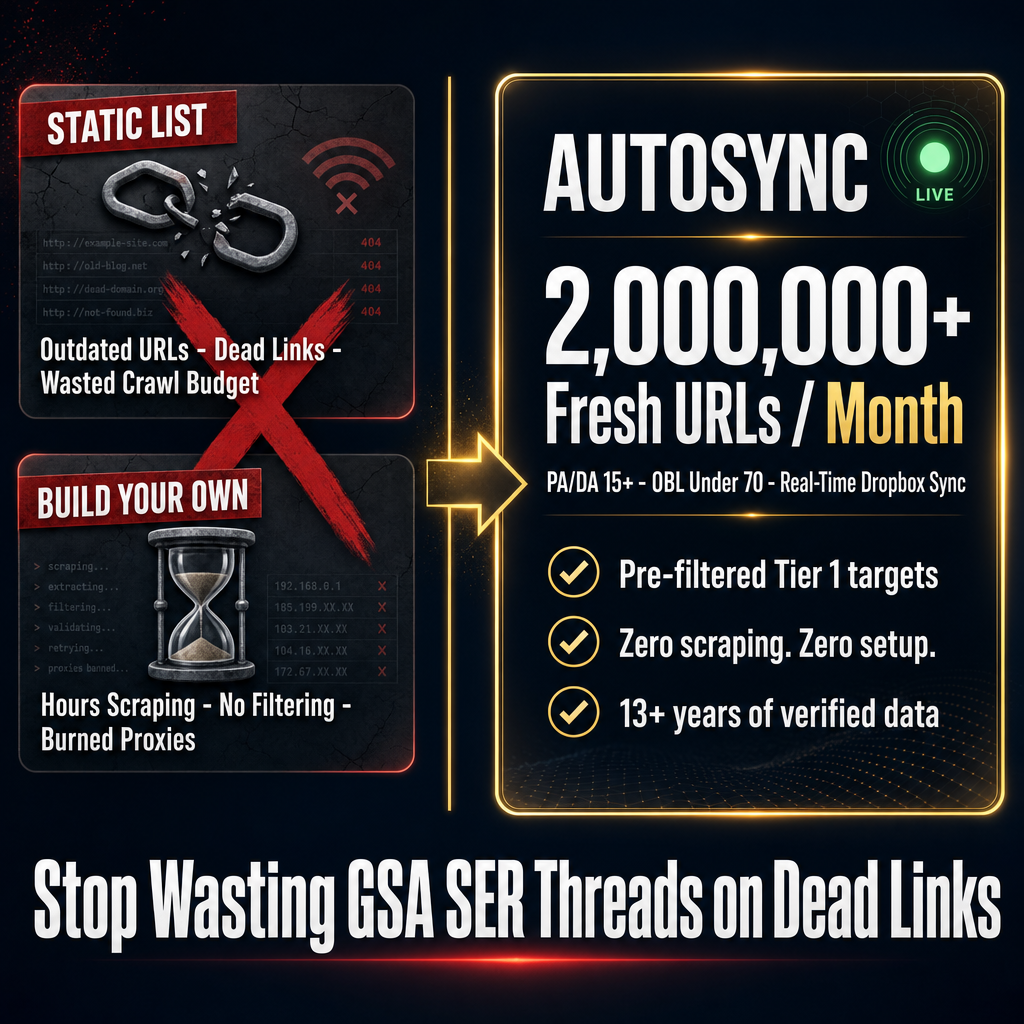
Generic verified link lists — the kind you download once from a forum or marketplace as a ZIP archive, a .SL file, or a raw text dump — start dying the moment the export is created. This isn't a fringe problem. It's structural.
Here's what you actually get when you buy one:
- A ZIP, .SL, or .txt file frozen in time at the moment of export
- No ongoing freshness updates or dead-URL removal
- No PA/DA filtering — every domain is treated the same regardless of authority
- No OBL filtering — you get high-OBL link farms mixed in with clean low-OBL targets
- No engine-coverage updates when platforms patch their submission forms
- No anti-spam pruning when a platform gets burned by everyone running the same dump
And here's what happens to that list over the following months:
- Sites go down, redirect, or change their CMS without notice
- Platforms that were accepting submissions get hammered by every GSA SER user who bought the same dump, causing IP bans and form lockouts
- Domain owners upgrade their spam filters or switch to newer captcha systems that old config files can't handle
- Verified links on stale domains eventually drop from Google's index entirely
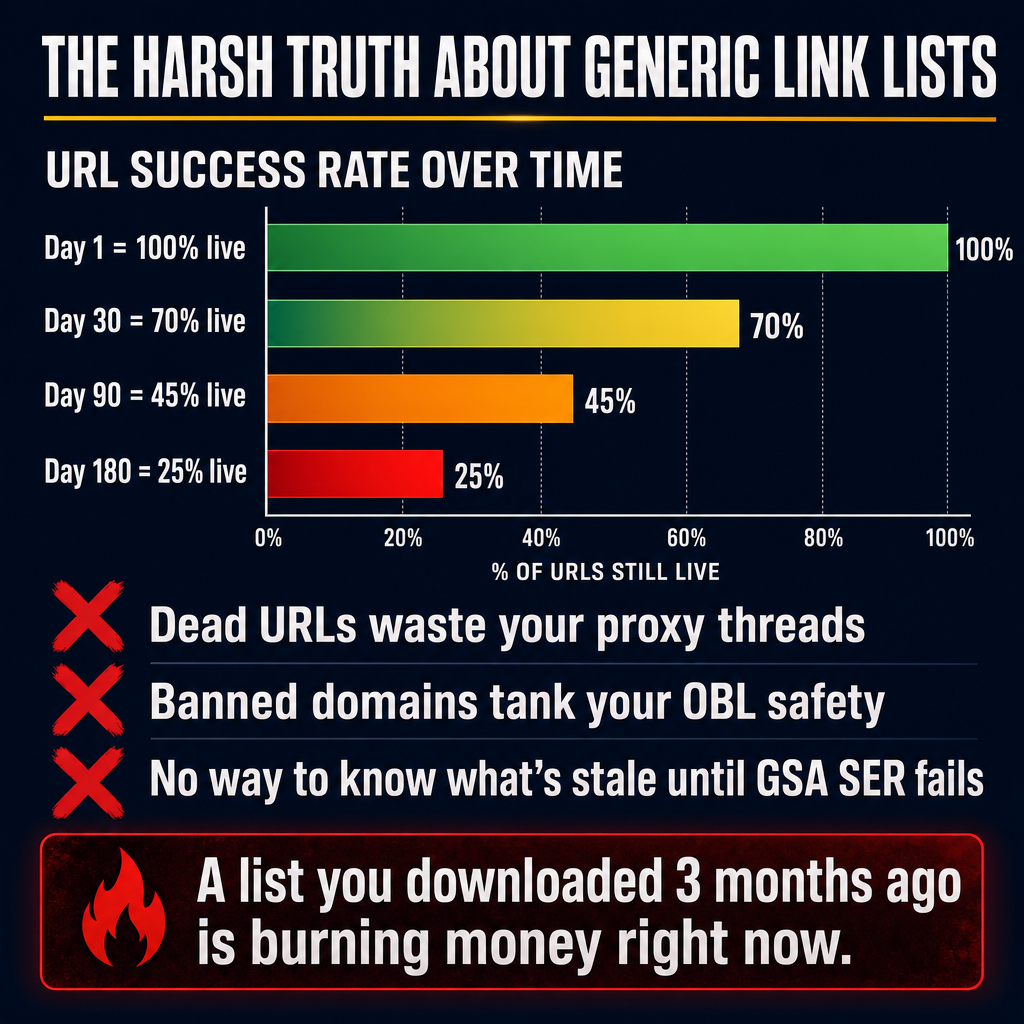
Within weeks you're not running a verified link list any more — you're running a spam-filled death list. GSA SER wastes proxy threads attempting submissions to dead endpoints, your LPM tanks, your captcha solver burns through solve credits on forms that will never succeed, and your verified-to-submitted ratio — the number that actually tells you if your campaign is healthy — deteriorates week by week.
The other hidden cost is opportunity. While your proxies are stuck retrying dead targets, they're not submitting to live ones. Every dead URL in your list is a slot that could have been a live verified link.
Building Your Own Verified Link List: What It Actually Costs in 2026
The "just scrape and build your own" answer sounds appealing on paper. In 2026 the math has shifted hard against it.
Scraping with regular private proxies is essentially broken in 2026. Google's bot detection eats them. Bing's defences aren't far behind. Search-operator harvesting that worked five years ago barely produces usable volume now. Modern anti-bot infrastructure is built specifically to defeat the kind of cheap rotating-proxy setups GSA users used to lean on.
If you genuinely want to build your own verified link list at scale today, the realistic stack looks like this:
- Paid SERP APIs — Serper, ValueSERP, SerpAPI, or Scrapingbee. Billed per query. You'll burn hundreds of thousands of queries to build a meaningful target pool.
- A-Parser — still functional, but you're paying for the license (~$179 one-time + addons), a dedicated VPS to run it 24/7, plus the API or proxy stack behind it.
- ScrapeBox / GScraper / Hrefs scraper — all still alive in 2026, all noticeably slower than they used to be. "Works in some niches, fails in others" tier — you can't depend on them as a primary engine any more.
- A verification VPS — separate machine running form-detection and OBL/PA-DA filtering against every harvested URL before it's safe to feed into a posting project.
- Ongoing maintenance — the freshly-built list starts decaying the same day it's finished. You're now running the verifier continuously, which means the costs above are recurring, not one-time.
For operators running multiple projects across different niches, the math rarely favours building your own. You're not just buying time savings — you're buying access to a verification stack that took 13 years to tune.
13 Years of Continuous Verification — Delivered Daily
SER Verified Lists has been running GSA SER campaigns since 2013. The verification infrastructure that took years to build and tune is already running. From $37/month, SERVL Sync delivers 200,000+ verified unique domains a month straight into your GSA SER folders, automatically.
View Packages →How SERVL Sync Works — and Why It Fixes the Freshness Problem
SERVL Sync is the delivery mechanism that separates SER Verified Lists from every static link list provider. Here's the exact flow:
- Our verification system runs continuously against the target database, removing dead URLs and adding newly-verified ones in real time
- SERVL Sync, our own Windows app, clones the processed, filtered folders to
C:\SERVL\on your machine every two hours over four parallel streams — dead targets removed, nothing to click - Inside GSA SER, Options → Advanced → Site Lists points at those folders, one per tier — set once
- Every time GSA SER reads targets for a new run, it pulls the current version of the list — always fresh, never the same stale file twice
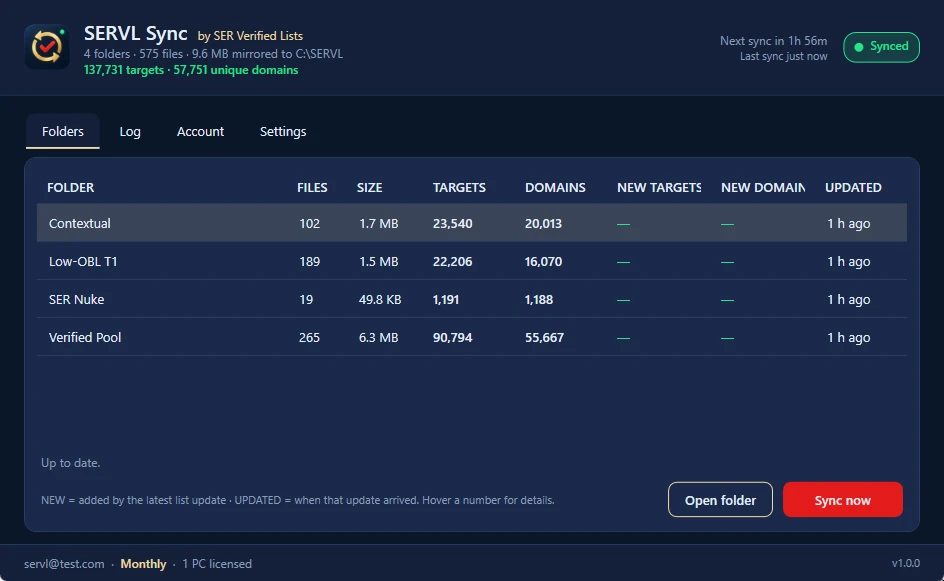
The practical difference shows up in your verified link rate. When GSA SER is submitting to targets that were confirmed live this week instead of three months ago, a higher percentage of submissions complete successfully. Your proxy threads spend more time posting and less time retrying dead endpoints.
The LOW OBL Folder — The Tier 1 Product Inside SER Verified Lists
Not all verified link lists are created equal, and not all URLs inside a list are safe for Tier 1. The LOW OBL folder is the subset of the SER Verified Lists database that meets the strictest quality criteria:
- PA/DA 15+ — only established, indexed root domains with measurable authority
- Outbound links under 50 — tight link profiles that pass meaningful PageRank per link
- Contextually relevant — contextual placements only — articles, wikis, web 2.0s and forum profiles — not footer spam
- Unique root domains — 200,000+ unique domains a month means you're not stacking 50 links on the same low-value platform
When you're building Tier 1 — the links that point directly at your money site — the LOW OBL folder is what you run. Running a Tier 1 campaign with a generic bulk list risks your money site's profile; running it with LOW OBL targets keeps it clean. The full walkthrough is in the Tier 1 LOW OBL guide.
Generic Static List vs. Build Your Own vs. SER Verified Lists (SERVL Sync) — Side by Side
| Factor | Generic Static List | Build Your Own | SER Verified Lists + SERVL Sync |
|---|---|---|---|
| URL freshness | Degrades immediately | Fresh if maintained | Real-time, always current |
| Setup time | Minutes | Days to weeks | Under 30 minutes |
| Ongoing maintenance | Manual re-downloads needed | Continuous VPS + API + proxy cost | Fully automated |
| LOW OBL / Tier 1 filtering | Rarely included | If you build the filter | Built in — dedicated folder |
| Volume (URLs/month) | Varies | Depends on API budget | 200,000+ unique domains / month |
| Cost | One-time, but recurring re-buys | Thousands per build cycle | From $37/month |
Pairing SER Verified Lists with the Right 2026 Tools
Getting the most out of fresh verified link lists still depends on the rest of your stack. In 2026, the setup that consistently delivers the best LPM:
- Captcha: Xevil 7 + reCAPTCHA module as the primary solver. It handles modern reCAPTCHA v2/v3 and hCaptcha that older solvers can't crack reliably. Set the internal timeout to at least 120 seconds. Pair with Reproxy IPv6 rotating proxies for Xevil's solving requests — IPv6 for the solver only, not for posting. Add CapMonster Cloud as a fallback.
- Proxies: Private IPv4 for posting — Rayobyte or BuyProxies at 5–10 threads per proxy. For Tier 1 with the LOW OBL folder, keep threads conservative — quality over volume.
- VPS: Solid SEO VPS or Green Cloud — both run SERVL Sync without issues.
- Content: SEO Content Machine wired to DeepSeek V4 Pro or Flash via API. Far better output than any pre-2025 workflow, cheap enough per article that there's no reason to run thin content on Tier 1 targets.
- Indexing: Speedy Indexer — credits back for any link that doesn't index, so you're only paying for links that actually land.
The full breakdown of every tool in this stack lives on the SER Verified Lists resources page.
Does Automated Link Building Still Matter in the AI Era?
The "SEO is dead" narrative gets louder every year. In 2026 it's accompanied by "LLMs will replace search" — and yet Google's AI Overviews still cite sources that have accumulated backlink authority. ChatGPT search and Perplexity still weight pages that have demonstrated trust signals over time. The mechanism hasn't changed; the destinations have multiplied.
Automated link building with GSA SER, run cleanly against quality filtered lists, builds those trust signals at a cost that manual link building can't match. The requirement that's changed is content quality: a Tier 1 link on a 1,000-word contextually relevant article written by a modern AI model carries far more weight in 2026 than a spun paragraph from five years ago.
The operators winning in 2026 aren't the ones who abandoned GSA SER — they're the ones who upgraded the inputs: better lists, better content, better captcha infrastructure.
Frequently Asked Questions
What is a GSA SER verified link list?
What's the difference between a generic verified link list and SER Verified Lists with SERVL Sync?
How often are SER Verified Lists updated?
How does SERVL Sync work with GSA SER?
What is the LOW OBL folder and why does it matter for Tier 1?
What proxy and captcha setup works best with SER Verified Lists in 2026?
How much does it cost to build your own verified link list in 2026?
Is link building with GSA SER still worth it in 2026?
Can I use SER Verified Lists with ScrapeBox or other tools?
Ready to Stop Running Stale Lists?
SERVL Sync starts delivering fresh, filtered verified targets to your GSA SER project from day one. No setup complexity. No ZIP files. No .SL dumps. 200,000+ verified unique domains a month, PA/DA 15+ LOW OBL folder included.
Choose Your Package →